BC Half Marathon 2026: 2h00'08 and the first mandala stage in the books
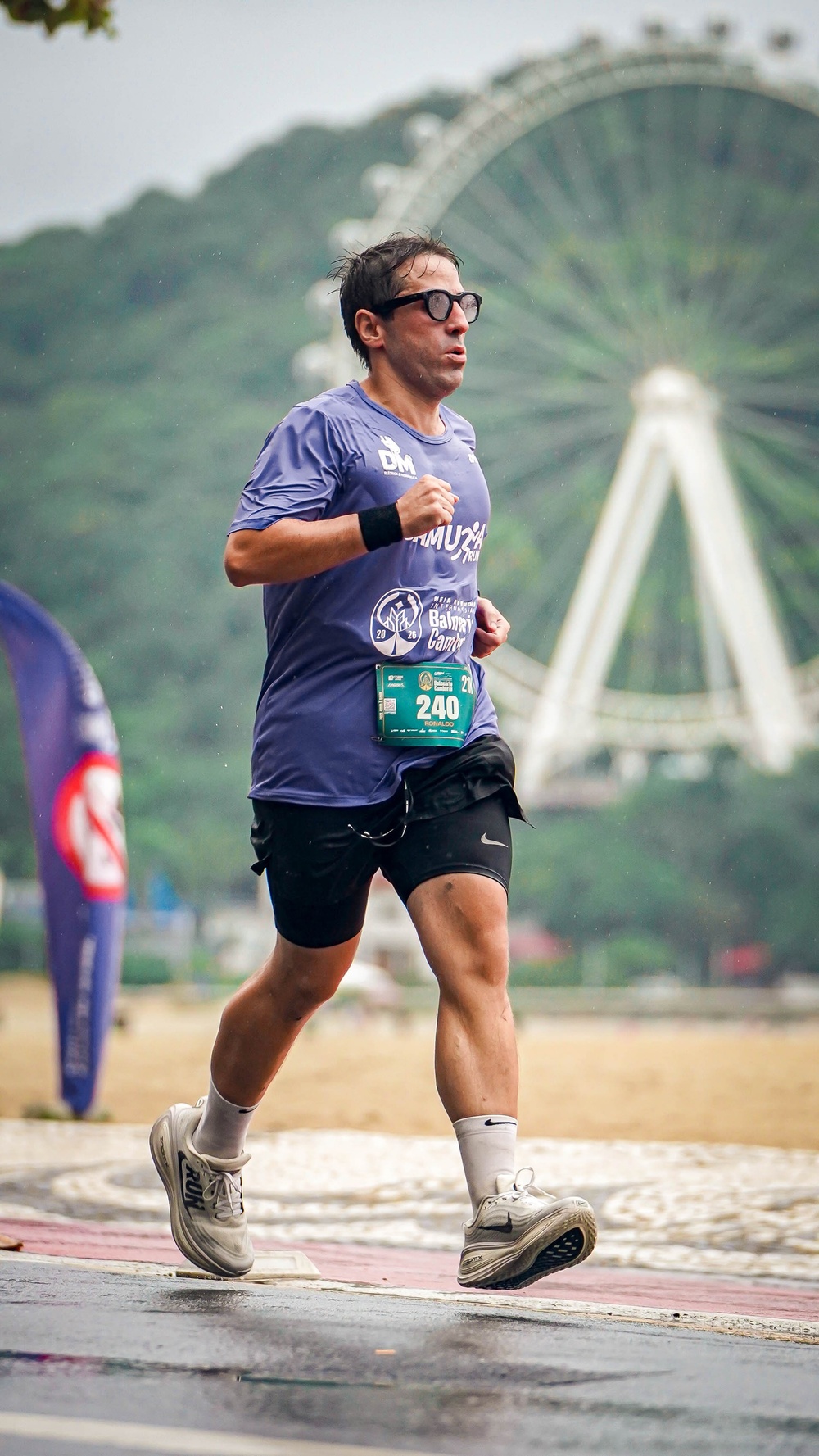
First mandala stage in the books. 2h00'08" on the chip, eight seconds shy of sub-2, more than two minutes under the most aggressive limit on my pacing plan.
Three-block negative split came in as designed. Estrada da Rainha climb without a single walking break. The plan happened, and then some.
If you read the race preview, here is the report on what actually went down on Sunday April 26. Real pace, what worked, what didn't, and what carries into the next stage.
Neste post
Start in rain and darkness
The local Climatempo forecast on April 24 had already painted the scene: 91% chance of rain, 14mm on Sunday. It nailed it. The rain came in early and stayed with me the whole race, always light. It never got in the way of running. The only loss was missing the sunrise along the seafront (sunrise in BC was around 6:36 AM), because the sky stayed shut all morning.
Start at 6:00 AM, with the general field released at 6:01. Still nighttime. The picture was the opposite of what I had imagined (oceanfront lit by the rising sun): wet asphalt, car headlights reflecting off the road, everyone soaked within the first few minutes.
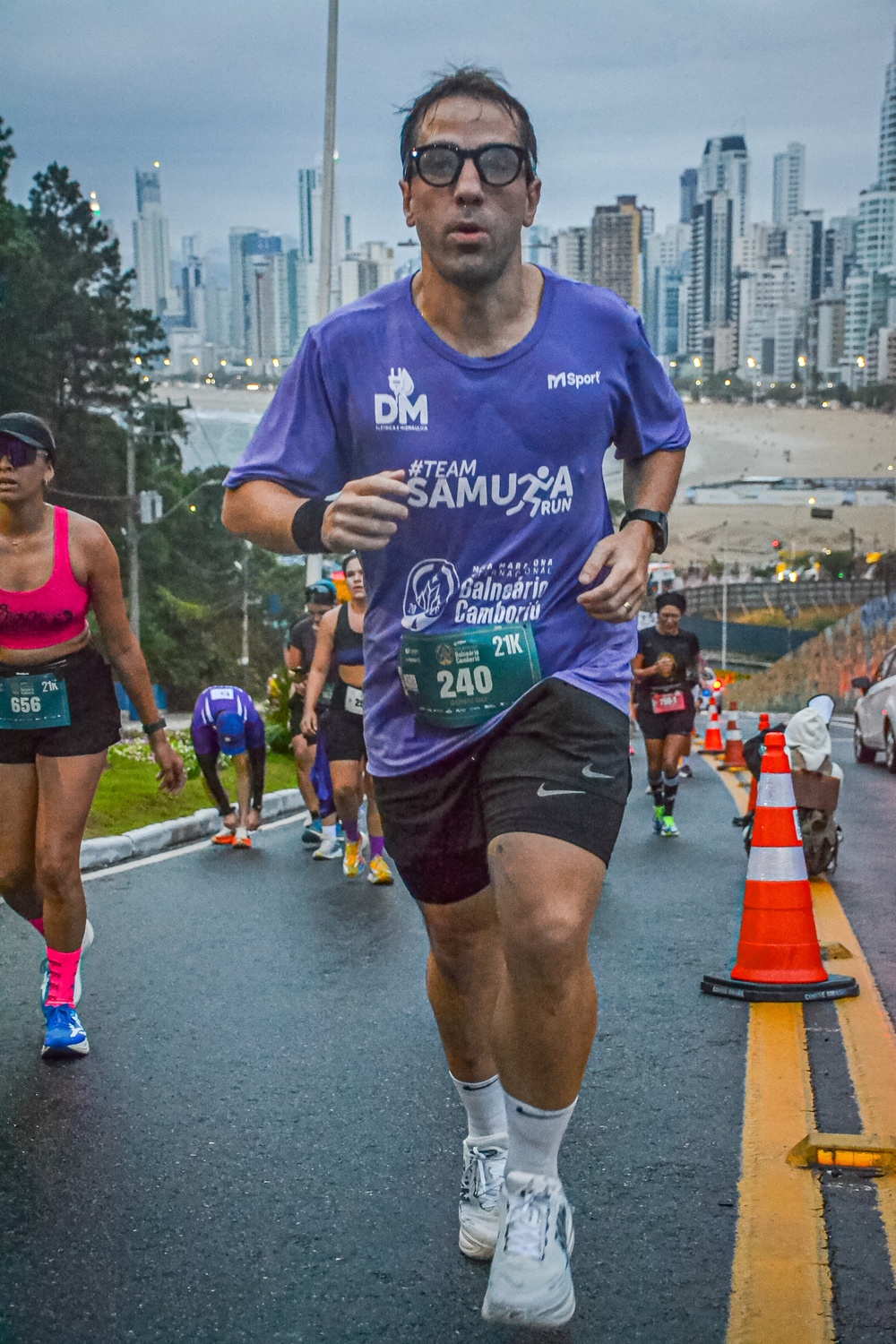
The first 2 km used both lanes of Av. Atlântica, with room for everyone. When it funnels down to one lane, the field had already spread out naturally and I never felt boxed in. The bottleneck design was well thought out.
Vomero Plus or Megablast: the shoe call
If you follow my Instagram, you saw me asking for opinions race week: should I go with the Vomero Plus or the Megablast?
The rain forecast shook the decision. The Vomero Plus is the shoe I trained the entire cycle in, more comfortable, the one my body already knew. The concern was that it would soak up more moisture in the rain and feel heavy late in the race. The Megablast was the alternative bet, with a profile that might hold less water.
I picked the Vomero Plus. Two reasons:
- Trust the gear that trained with you. Switching shoes on race day is a risk worth avoiding. 21 km in the rain in less familiar shoes is a problem multiplier.
- Comfort. The whole training block was in it. My body already knew the ride.
It was the right call. The Vomero Plus held up well in the rain, did not feel heavy at the end, and I finished with no discomfort, no chafing, no blisters. It confirmed the rule: the shoe you train in is the shoe you race in.
Estrada da Rainha without walking
The climb that decides the race is the Estrada da Rainha. I already expected it around km 7 (the size of the beach gives the math away). I ran both faces of it, no walking breaks at any point.
| Pass | Section | Pace |
|---|---|---|
| 1st (outbound, shorter and steeper) | km 6 and 7 | 6:30 and 6:18 |
| 2nd (return, longer and less steep) | km 15 and 16 | 5:50 and 6:44 |
The 1st face concentrates the elevation at the start of km 6 and eases off at km 7. The 2nd face is more spread out: you can hold race pace through km 15, and the cost shows up at km 16.
When I crested the second climb and hit the final descent, that was the moment I realized I had more legs than expected. That is when I decided to open up the pace for the last 5 kilometers.
The pacing plan worked
Samuka built the plan in three blocks with a pace window for each one. The plan was a negative split: start contained, hold in the middle, accelerate at the end.
All three blocks came in faster than the lower bound of the window.
| Section | Plan | Real | Split |
|---|---|---|---|
| Km 1 to 5 | 6:00 to 6:05 | 5:53 | 29:25 |
| Km 6 to 15 | 5:50 to 6:00 | 5:52 | 58:37 |
| Km 16 to 21.15 | 5:40 to 5:45 | 5:16 | 32:14 |
Block 1 came in 7 seconds per km below the fast end. Block 2 sat right in the middle of the window, with both Rainha climbs (km 6-7) inside it. Block 3, with the second climb at km 16 and the “I have legs” feeling after it, came in 24 seconds per km under plan. Without km 16 (the return climb), the pace for the last 5 km closed at 4:58.
Official result (Chip Timing):
| Metric | Value |
|---|---|
| Net time (chip) | 2h00’08” |
| Gun time | 2h04’20” |
| Average pace | 5:43 min/km |
| Overall placement | 615 |
| M40-44 placement | 112th |
Garmin (recorded by the watch):
| Metric | Value |
|---|---|
| Total time | 2h00’16” |
| Distance | 21.15 km |
| Average HR | 151 bpm |
| Max HR | 174 bpm |
| Average cadence | 166 spm |
| Total ascent | 139 m |
| Calories | 1706 |
The plan window was 2h02’49” to 2h05’28”. The clock came in 2 minutes and 41 seconds under the most aggressive limit of the window.
Splits per km (Garmin)
| KM | Pace | HR | KM | Pace | HR |
|---|---|---|---|---|---|
| 1 | 5:52 | 136 | 12 | 5:41 | 151 |
| 2 | 5:50 | 141 | 13 | 5:36 | 152 |
| 3 | 5:55 | 141 | 14 | 5:34 | 150 |
| 4 | 5:57 | 141 | 15 | 5:50 | 152 |
| 5 | 5:50 | 143 | 16 | 6:44 | 155 |
| 6 | 6:30 | 149 | 17 | 5:11 | 158 |
| 7 | 6:18 | 149 | 18 | 5:07 | 160 |
| 8 | 5:46 | 147 | 19 | 5:03 | 162 |
| 9 | 5:52 | 150 | 20 | 4:48 | 164 |
| 10 | 5:41 | 150 | 21 | 4:43 | 169 |
| 11 | 5:50 | 150 |
Rows in bold: the two faces of Estrada da Rainha. HR climbed in a natural curve (135 to 168) without spiking too early. The final sprint at km 21 closed at 4:43 pace with max HR of 174.
The eight seconds
Eight seconds short of sub-2.
It is no longer just a number now: it is the start line of the next race. Oakberry Floripa Half is on May 3, four more mandala stages run through September, and sub-2 becomes a concrete target for one of them. The body responded beyond what the plan asked, so the adjustment to attack it is consistent training, not magic.
Nutrition and hydration delivered
This was the block where I followed the plan to the letter, and it paid off.
Night before: beef sandwich. Simple carbs and protein, nothing exotic.
Race morning:
- Banana
- Oat bar
- Dobro NIT 400 (beetroot drink)
- 1 YoPro (23g of protein)
During the race:
- 3 Z2 gels: two carb-only across the first two thirds, one with taurine and caffeine in the final stretch for a kick
- 1 Z2 dissolvable salt (500mg)
- Hydration at almost every aid station. Did not need to carry water
The organization delivered well on aid: water every 1.5 to 2 km, isotonic at the right spots (km 11.9 right after the top of Rainha, km 17.9 in the final stretch), bathrooms with no lines when I needed them. This pillar of the race did not miss anywhere.
The finish came earlier than I expected
I had studied the course thinking start and finish were exactly at the same point, down at Barra Sul. On race day, I found out the finish was at the arena, around 500 meters short of Barra Sul along the course direction. The official distance came in at 21.09 km, exact.
Result: in the final kilometers I was mentally ready to cross the line further ahead. When the arena appeared, I had legs to spare instead of having to push. Helped the closing pace.
Organization: arena, festival, and infrastructure on point
Race Sunday delivered everything:
- A well built arena, with several running coaches present, good booths, and live music
- Course support without misses (water, isotonic, bathrooms)
- Punctual start with well distributed waves
- 3-hour cutoff giving everyone enough room to finish
For a race that debuted as an official stage of the Circuito Catarinense in 2026 and pulled more than 5,000 athletes across the weekend, the Sunday 21k was an exemplary execution. Hats off to the organization.
What is worth noting for 2027
Saturday had a detail worth the organization looking at carefully for next year. The 5k and 10k ran in the late afternoon on the sand at Barra Sul, and the course design got challenging: after the recent beach widening, the strip of hard, wet sand became narrow and tilted, and the rest is very soft sand. The aid stations sat on the boardwalk, about 50 meters off the running path, so anyone wanting water had to step off route and back.
There were cases of runners getting sick. It is a point worth the organization rethinking for 2027: adjusting the layout, bringing hydration closer to the route, or evaluating moving everything to asphalt as the 21k already is. The charm of a beach race stays intact, and a few tweaks only make it run better.
Next mandala stage: Oakberry Floripa, May 3
Next Sunday is stage two: Oakberry Floripa Half, May 3. Seven days between races, so the week is more about recovery and logistics than training.
I will come back here with the Oakberry report. And sub-2 stays on the calendar.
If you ran BC this year, share in the comments how your race went: what worked, where it stung. And if you are putting together your own mandala (Catarinense or another one), the report and the race preview add up to help you show up with a plan next time.
Sources
- Official result: Chip Timing / FIBRA Sports finisher certificate, Meia Maratona Internacional de Balneário Camboriú 2026
- Race preview, with pace plan, course, elevation, hydration, and weather
- Samuka, running coach behind the pacing plan
- Official BC Half Marathon 2026 site
- Circuito Catarinense 2026 calendar
Images:
- Hero (oceanfront with FG Big Wheel in the background): Photo Luann Carvalho / Foco Radical
- Av. Atlântica during the first km with skyline: Photo Cleiton Benkendorf / Foco Radical
Follow Tênis e Milhas
Next race previews, training and travel land here first: