Floripa 31k Challenge: the medal that changed my race plan
Neste post
Friday: the medal that changed the plan
I arrived in Floripa with a clean plan: attack the sub-2 in the 21k that escaped by 8 seconds at the BC Half seven days before. The target was surgical: same Samuka pacing plan, same shoe, same three-block negative split strategy. The Floripa 31k Challenge had never been on my radar. I didn’t even know it existed.
Kit pickup is at Villa Romana Shopping. I went up to floor G2 on Friday afternoon, and that’s where the plan came apart.
The Floripa 31k Challenge medal was on display. It’s a large piece, with an extra layer that snaps into the 10k and 21k medals to form a complete set. The three together carry visual weight that neither of the individuals achieves alone. The collection effect lands.
I left the mall with the call made: I’m running the challenge.
The logistics: kit sold, kit bought
There’s an operational detail worth recording: the organization does not allow an official upgrade from 21k to 31k at kit pickup. If you registered for the half, you stay on the half.
The fix came through the parallel inscription market, in the WhatsApp group for runners on this race:
- Sold my 21k kit for R$280 to a runner who’d given up on registering.
- Bought a 31k Challenge kit from another athlete who’d registered but couldn’t travel, for R$330.
- Net cost of the swap: R$50.
Fifty bucks for the extra medal, 10 extra kilometers on the weekend, and a back-to-back 31 km test inside 24 hours. Not a little, not a lot, it’s the price tag on a Friday-afternoon decision when the flight’s already booked and the body’s already trained.
Important if you’re doing something similar at another race: always confirm the official transfer through the registration platform when possible. A kit “passed in the dark” without a registry update can cause issues at timing or at start-line ID checks.
Carb load with Rafa Caviquioli
Race plan changed and so did the food. I messaged Rafa Caviquioli (@rafael_caviquioli), a sports nutritionist who works with endurance runners, and he reworked the weekend’s carb load.
Difference vs a solo race: with a 10k Saturday morning and a 21k Sunday morning, the recharge window between the two races is tight. The body burns most of its glycogen in the 10k, rests for ~24 hours, and has to be ready to run 21 km the next day.
The protocol he sent covered the full weekend: what to eat and when, from the days leading into the 10k to the morning of the half, with a specific replenishment window between the two races.
I’m not opening the number-by-number detail here because what works for me (weight, calorie expenditure, race pace) doesn’t translate as a recipe for you. The point is different: having a sports nutritionist in the last-minute decision flow is what unlocked it for me to not show up to Sunday’s half feeling unsure. Without Rafa building the replenishment window between the two races, I probably would have backed out and stayed on the 21k to avoid the fatigue risk.
Today’s 10k: 58’36” reining the horse
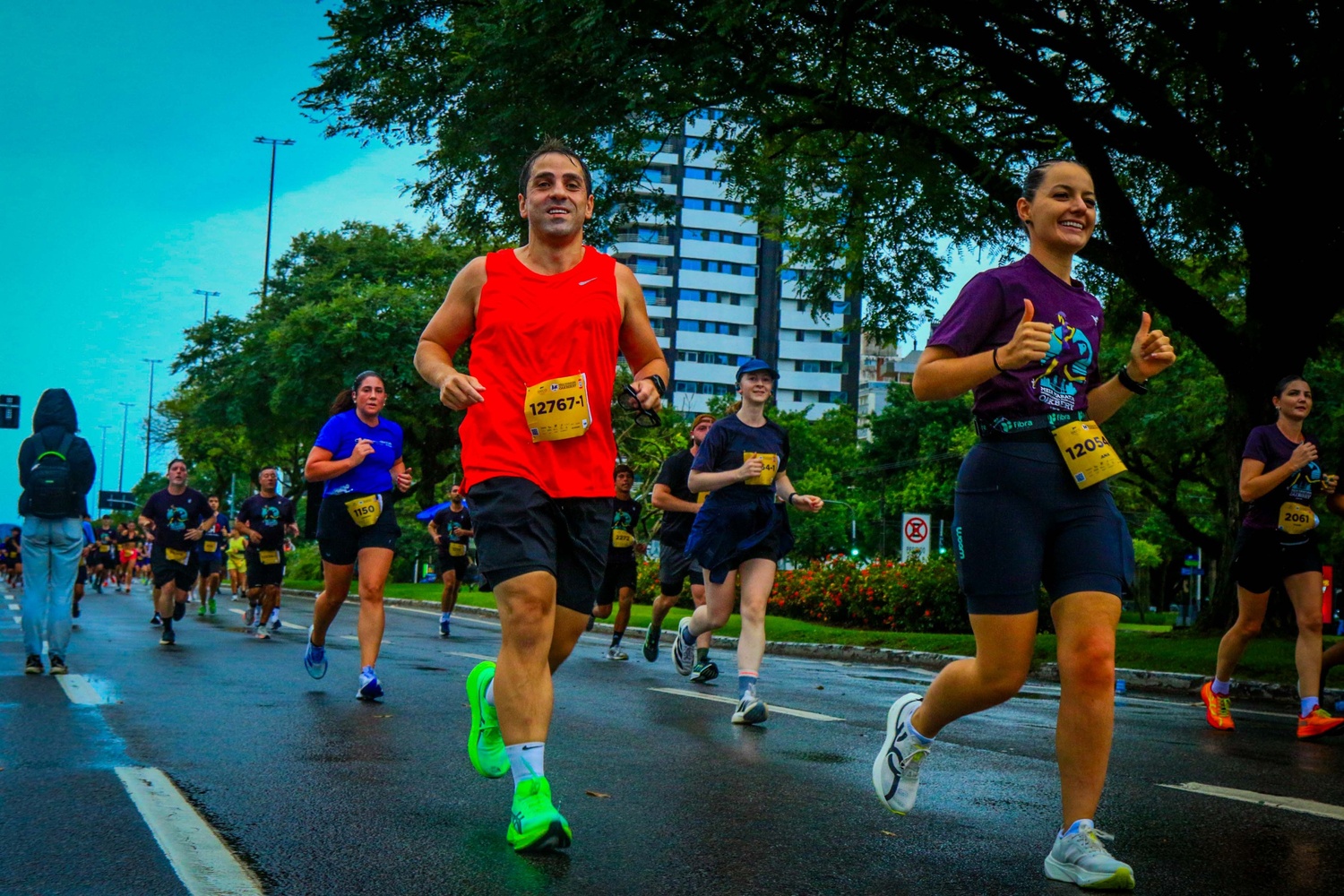
The 10k went off at 6:45 AM from the Trapiche da Beira-Mar Norte. Comfortable cold, ~14°C, no rain, light wind. Pavement was wet from morning dew but didn’t compromise grip.
The hero photo of this post was taken by the race photographers in the early kilometers, still on the Beira-Mar. Big field, but no bottleneck.
The goal was to hold pace, 10k is a distance where the urge to open up runs high, and with 21 km the next day, every five extra seconds per km today turns into thirty lost seconds tomorrow. Plan: run between 5:45 and 5:55 min/km, HR below 150, no kilometer under 5:30 until km 9.
The plan came in and then some. Official result:
| Metric | Value |
|---|---|
| Chip time | 58’36” |
| Average pace | 5:51 min/km |
| Official distance | 10.0 km |
Garmin (logged on the watch):
| Metric | Value |
|---|---|
| Total time | 59’04” |
| Distance | 10.29 km |
| Avg HR | 142 bpm |
| Max HR | 166 bpm |
| Avg cadence | 164 spm |
| Avg stride | 1.06 m |
| Elevation gain | 11 m |
| Calories | 811 kcal |
Splits km by km
| KM | Pace | Avg HR | Max HR |
|---|---|---|---|
| 1 | 6:14 | 133 | 137 |
| 2 | 5:55 | 136 | 141 |
| 3 | 5:46 | 140 | 146 |
| 4 | 5:47 | 140 | 145 |
| 5 | 5:44 | 142 | 147 |
| 6 | 5:34 | 147 | 155 |
| 7 | 5:50 | 144 | 149 |
| 8 | 5:49 | 142 | 145 |
| 9 | 5:44 | 144 | 156 |
| 10 | 5:15 | 148 | 158 |
From km 1 (6:14) to km 10 (5:15), pace dropped 59 seconds per kilometer without HR ever crossing 158 bpm outside the final sprint. Km 10 came out fast naturally, no forcing. Sign of legs to spare. Which is exactly what I want for tomorrow.
Compared to BC 7 days ago:
| Race | Avg pace | Avg HR | Max HR |
|---|---|---|---|
| BC Half (21k, Apr 26) | 5:43 min/km | 151 bpm | 174 bpm |
| Oakberry 10k (May 2) | 5:51 min/km | 142 bpm | 166 bpm |
Today I ran 8 seconds per km slower than BC’s half-marathon pace, with HR 9 beats lower. Sub-aerobic effort for a 10k. That’s how it was supposed to be.
Recovery between the two races
Headed straight back to the hotel. Lunch from Rafa’s plan, basic stretching, and the two physical pillars of the afternoon:
- Pneumatic compression boot: 30 minutes at high pressure, especially calves and quads. The boot moves circulation that the body would take hours to do on its own.
- Foam roller for myofascial release: focus on quads, hamstrings, glutes, and plantar fascia. No new technique here, same protocol as the long-run cooldowns.
Afternoon: continuous hydration + carbs per Rafa’s plan. No caffeine after 2:00 PM, to protect sleep. Light dinner around 7:00 PM. Bed early.
21k tomorrow with 10 km already in the legs
The obvious question: how is the 21k going to run tomorrow with 10 km from the day before still in the legs?
Honestly, I don’t know yet. But I have hypotheses:
- Sub-2 is off the table tomorrow. It’s not worth attacking 5:40 min/km pace with partially used glycogen and residual fatigue. Sub-2 stays for another mandala stage, with a clean race week.
- New plan: finish in one piece, no walking, controlled HR. Goal tomorrow is to close the 31 km of the challenge without breaking down. Estimated pace: 5:55 to 6:05 min/km, between today’s pace and the upper limit of BC’s window.
- More aggressive hydration and gel. With reduced glycogen, I depend more on in-race carbs. I’ll use 4 gels (1 more than at BC) and take isotonic at every aid station.
Real outcome won’t drop until tomorrow at noon. I’ll be back with the report.
What changes for the mandala
The first mandala stage (BC) came in at 2h00’08, eight seconds shy of sub-2. The second (Oakberry, tomorrow) will run with held-back pace because of the challenge. The sub-2 window reopens in the next stages:
- Chapecó (Aug 2), stage 4
- Floripa International Marathon 21k (Aug 29), stage 5, with the bonus of being the same course as Oakberry
- Criciúma (Sep 27), stage 6, season closer
Samuka’s half-marathon plan stays valid. What changes is the sequence: I attack sub-2 when I have a clean race week, no 10k the day before. For now, the 31k challenge buys the extra medal.
Fifty reais and a Friday call
To wrap the path to the Floripa 31k Challenge: saw the medal Friday, swapped kits for R$50 net, adjusted nutrition with a sports nutritionist, ran 58’36” at the 10k holding pace, full recovery, and tomorrow I line up for the half with 10 km in my legs and the goal of closing the full challenge.
It wasn’t the “right” call in the technical sense, sub-2 escapes for one more race. It was the interesting call, which is usually what justifies documenting. Switching to the Floripa 31k Challenge cost fifty reais and five minutes of WhatsApp; the medal collection earned every one of them.
If you also ran the 10k today, or also switched to the challenge last-minute, drop it in the comments. And if you’re running the half tomorrow, see you at the Trapiche at 5:30 AM.
Sources
- Oakberry Floripa Half 2026 preview
- BC Half 2026 race report (mandala stage 1)
- 2026 Circuito Catarinense calendar
- Rafa Caviquioli, sports nutritionist (@rafael_caviquioli), built the weekend carb load
- Samuka / Team Samuka Run, coaching team responsible for the race plan
- Official 10k result: finisher certificate Sportsland / Ticket Sports, Meia Maratona Internacional de Florianópolis Oakberry 2026
- Garmin Fenix 7 Pro data (.fit file)
Images:
- Hero (Beira-Mar Norte, 10k): Photo Buru Casal do Rock
Follow Tênis e Milhas
Next race previews, training and travel land here first: